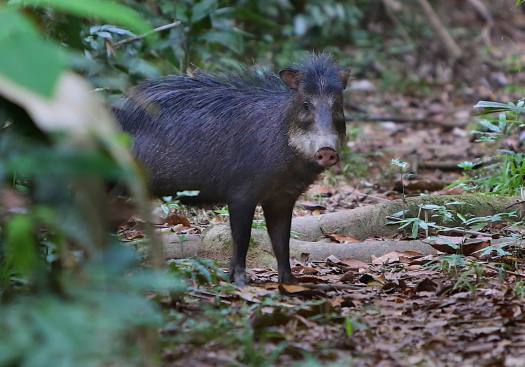
White-lipped peccary in the Amazon (copyright and photo Jose MV Fragoso)
News article from Virginia Tech University on our research: “Evidence of wildlife passage, such as tracks, scat, fur, and disturbed surroundings, is a more accurate tool for assessing wildlife conservation status than actual encounters with animals, according to an international team of scientists from six universities, publishing in the April 13, 2016, issue of PLOS ONE.” Continue reading “Community livelihoods depend upon accurate wildlife estimates”
Muheres Uaiuais preparam farinha de mandioca tradicional (Foto: José Fragoso)
“Populações habitam a região amazônica há milhares de anos, mas o avanço de elementos da vida moderna está pondo em risco a sustentabilidade desses povos e do ecossistema onde vivem. Essa é a conclusão de um estudo elaborado pela equipe do biólogo português José Fragoso, da Universidade Stanford, nos EUA.” “ — Os resultados da pesquisa mostram que apenas não invadir áreas indígenas não é suficiente — diz Fragoso. — O que acontece no entorno das reservas tem grande impacto no interior.”
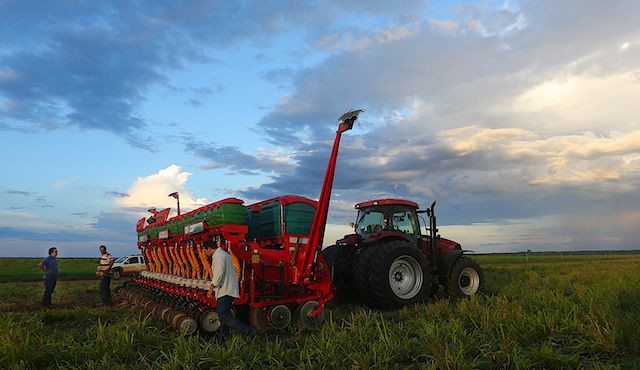
Preparing field for planting soybeans near indigenous land in the Cerrado of Brazil (Photo copyright by Jose Fragoso )
Our latest publication is out in Frontiers in Ecology and The Environment. We examine the socio-environmental sustainability of protected areas inhabited by indigenous and rural peoples and describe how socio-ecological change and development (e.g., forest clear-cutting outside indigenous areas, religious conversion, improved child mortality rates and introduction of resources from outside) outside these areas influences the sustainability of biodiversity, forest cover, and people inside. There are some surprising results so read the publication!
Agro-industrial soy bean farm adjacent to forest of an indigenous area in Brazil (photo Jose Fragoso)
Research collaborators Takuya Iwamura, Eric Lambin, Kirsten Silvius, Jeffrey B Luzar, and José Fragoso have a new paper in press. The publication examines the resiliency and sustainability of biodiversity, human livelihoods and forest cover within Amazonian indigenous lands under various future development scenarios. The paper is scheduled for publication in the February 2016 issue of the journal “Frontiers in Ecology and the Environment”.
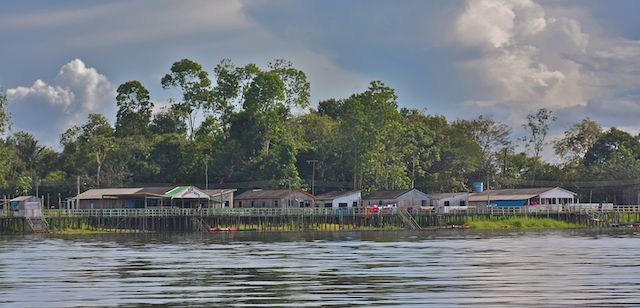
Village by an Amazonian river (photo by Jose Fragoso)
We have completed a major work describing the sustainability of hunting, farming (land use) and local livelihoods in the tropics. We devised an agent based computer simulation model and explored the relationships between the above mentioned elements to consider what the future may hold for tropical forest biota, ecosystems and peoples.
Iwamura T., Lambin E., Silvius K.M., Luzar J.B. & Fragoso J.M.V. 2014. Agent-based modeling of hunting and subsistence agriculture on indigenous lands: understanding interactions between social and ecological systems. Environmental Modelling & Software, 58: 109-127.
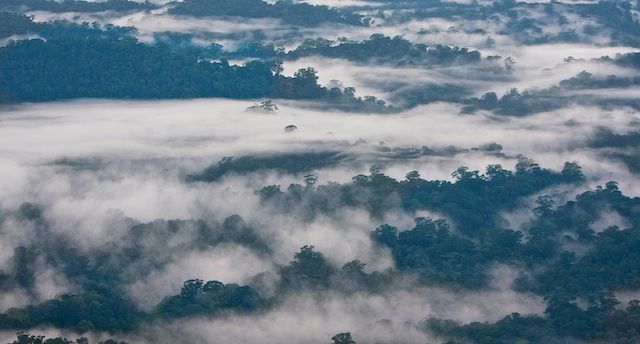
Low hanging clouds over the Amazon forest (photo Jose Fragoso)
Isabel Jubes of KZSU 90.1 FM Radio Stanford interviews Jose Fragoso concerning the State of the Amazon Forest. KZSU broadcasts Latino and Hispanic Culture to the world.




 Fragoso Lab